
Making their way in the Russian Empire
Making their way in the Russian Empire
A recent Financial Times article indicates that South Korea is planning to open a sea route through the Arctic to Europe to improve trade routes to Europe.

English explorers had the same idea many centuries earlier except they were trying to find an Arctic route to the East Indies.
Ice has always been a problem. In 1553, a London trading company searching for a route to the East Indies, commissioned Hugh Willoughby to search for a northeast passage to China.
He had a fleet of three ships with the Edward Bonaventure being captained by Richard Chancellor.
It would be a perilous voyage as little was known of the Arctic waters. How perilous it was soon became evident when Willoughby and his crew froze to death.
Chancellor was more fortunate and sailed into the White Sea before anchoring off the Russian port of Arkhangel.
Russia was little known in England, its overland route being barricaded by European nations and conflicts in the Baltic Sea.
The ruler of Russia, Ivan the Terrible, invited Chancellor to Moscow where a trade agreement was established with furs, hemp and tallow heading back to England with woollen cloth heading the other way.
Over the next three centuries the English monarchs appointed representatives to the Tsars’ court, most of whom appeared to be charged with protecting English commercial interests.
In 1800 a formal trade pact was agreed.
Soon ships were arriving at Hull from Arkhangel and St Petersburg carrying wheat, tar, iron and flax. They also brought what was the flavour of the day - Russian hair oil!
In 1816 the Tsar bought all his army’s cloth from Leeds manufacturers and Russian cloth could be found in Sheffield market.
By the second half of the nineteenth century, Hill House School was recruiting from Russia and the Mexborough area pits were sending their coal north.
Later, auctioneers Sheerman and Johnson were importing pit ponies from Russia.
Political events frequently interfered with the relationship but the main barrier to trade was that the Russian northern ports were frozen for eight months of the year.
Throughout the nineteenth century Britain and Russia faced off in what was known as the Great Game, the attempt by both countries to influence the futures of Afghanistan, Persia and Tibet.
Though it never developed into outright war it was marked by both countries using proxies to gain influence.
Britain’s greatest fear was of a Russian invasion of India while Russia was concerned with its expanding empire in Asia and by the British meddling in what they saw as their empire.
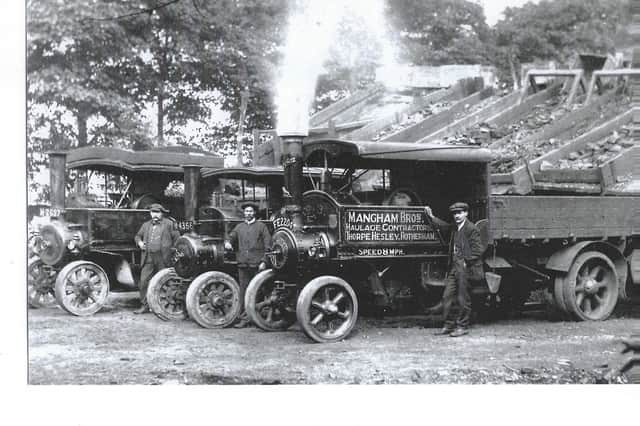
Despite this geopolitical activity occasionally impacting on trade it did not deter an enterprising Thorpe Hesley mining family from looking for opportunities abroad.
Arthur Mangham, having grown up in the Horse and Tiger where his collier father was also landlord, married Clara Burgin in Thorpe and with her had two sons and a daughter.
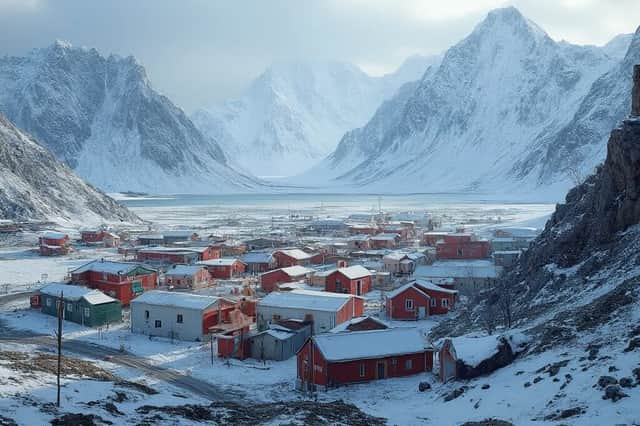
Despite the freezing temperatures, Arthur saw the opportunity to make his fortune on the barren island of Spitzbergen, now known as Svalbard, in the Arctic Circle, the setting for the BBC`s most recent series of Vigil.
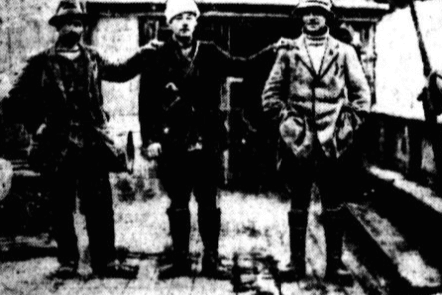
Arthur Mangham took his surveying talent to the far north where he was followed by his eldest son, Bertram, who would spend 20 years in Svalbard, returning each summer to recruit local miners for this challenging environment.
In 1912 he returned to the island with ten local men.
Bertram was credited with the success of the Arctic Coal Company which extracted one million tons from the frozen island.
They faced many problems including the fact that Svalbard was ice locked for eight months of the year.
Arthur spent seven winters on the island while Bertram spent 20 before returning to Thorpe Hesley in 1920.
The money the Mangham’s earned enabled them to form Scholes Colliery Ltd in 1891 and they were soon able to add the Jordan and Meadowhall Pits to their portfolio.
The pit was not without problems. In 1886 inspectors had claimed that there was inadequate ventilation for which they were fined £3 with the inspectors claiming that there was hardly a rule not broken!
On his return, the now well-off Bertram invested his money in the mining business.
Unfortunately, Bertram was not as successful as he had been in Svalbard. During heavy rain a stream was diverted by local people with the water ending up deep in the pit.
The death of Arthur in 1923 hit him hard and over the next ten years the profitability decreased, partially due to his administrative failings, one of which was failing to pay National Insurance contributions for some of his workforce.
By 1928 the pit was only employing a few men and by 1940 was defunct.
Meanwhile, Leonard, the younger son, began to develop a transport business, eventually acquiring the Moorgate Garage which sat opposite the top of Mansfield Road.
It also played a part in the mining business.
The Manghams were not the only people who took their mining skills to new frontiers.
In 1913 James Elce, the popular manager of Silverwood Pit, accepted a post with the New Russia Company who were exploiting the coal in what is now the Donetsk.
He stayed in Russia for seven years before leaving as a result of the chaos sparked by the fall of the Romanovs in the Russian Revolution.
The British Royal family were closely connected to the ruling Romanovs as can be seen when Victoria`s son Alfred, the Duke of Edinburgh, married Maria Alexandra Romanov in 1874.
Locally Lady Mary Fitzwilliam was appointed Lady in Waiting to the new Duchess.
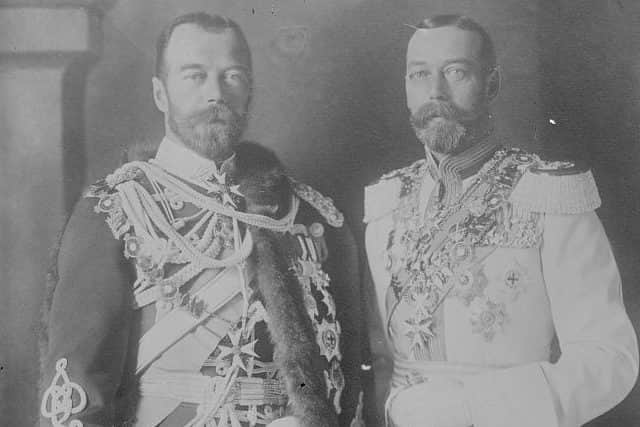
In the same year that Elce set off for Russia the Tsar Nicholas was being photographed with King George V. The genetic link of the Windsors with the Russian ruler was obvious. They were however, very different in that the English King was bound by constitutional rules while the Tsar was an autocrat whose word was paramount.
When World War One broke out the two monarchs were in accord about the German threat.
Like Elce another local mining man, Arthur Horsefield, had left in 1883 to join the New Russian Company.
He trained at Denaby and local pits before marrying Catherine Stenton of Mexborough and heading out to Russia where he sank, at the time, the deepest pit shaft in Russia.
They returned in 1909 after 16 years.
Arthur believed that the Russian peasant regarded Tsar Nicholas with loyalty and reverence and was hugely impressed by the Cossack troops.
Unfortunately, his political judgement was fallible as unrest in the country was growing culminating in the 1917 revolution which brought the Bolsheviks to power.
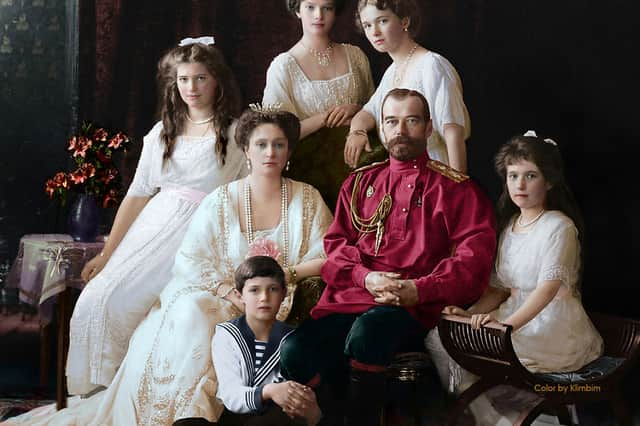
One Rotherham man, Charles Sydney Gibbs, born in 1876 to the manager of the old bank at the bottom of High Street, was an eyewitness to these events.
His travels took him to St Petersburg where he became tutor to the children of two aristocratic families before being recruited by the Empress Alexandria to improve the English accents of her children.
Sydney later expressed his dislike of Alexandria’s guru, the monk Rasputin. Gibbs recalled him as a naïve peasant with cunning.
He was subsequently appointed tutor to Alexi, the heir to the Russian throne.
In the October of 1917 the seething discontent erupted. The Romanov royal family, were imprisoned. Attempts were made by the now dominant Bolsheviks to exile them.
Unfortunately, the British government refused to provide sanctuary so they ended up at Ipatiev House near Ekaterinburg where the entire family were murdered in 1918.
Gibbs had travelled with them to Ekaterinburg but was not allowed to join the family at Ipatiev House. He fled east to Harbin in Manchuria but not before acquiring some souvenirs including Faberge jewellery and, somewhat surprisingly, a Murano chandelier which reached Oxford via Manchuria.
Harbin was a favourite with the White Russian emigres and a centre for opposition to the Soviet regime. Notably, they were notoriously anti-Jewish.
In Harbin the Russian emigres formed the Russian Fascist Party, members of whom fought for Germany and Japan in World War Two.
Gibbs spent a number of years as part of this community before returning to Britain in 1937 and reinventing himself as Father Nicholas, head of the Russian Orthodox Church in Britain.
He based himself in Oxford and catered to the aristocratic White Russian émigré community.
At some stage he ‘adopted’ George Paveliev and set him up with a farm in Kent.
When his wife later sought a divorce she commented that his father was all controlling. The judge commented that Father Nicolas was the cause of the marriage breakdown.
His final years were spent in a house he had bought in Camden Town where he lived in a single spartan room decorated with six magnificent ikons.
When he had a heart attack he was admitted to St Pancras Hospital where he was nursed in his final weeks by Ann Scupholme.
She recalls that he frequently raved against the Russian peasants whom he said were uneducated, ungrateful and should have remained subservient in gratitude to the Tsar.
He spoke much of his life in the Romanov court but mentioned only one woman, the Empress Alexandria.
Ann Scupholme said he had no visitors.
He died in 1963, leaving £14,000.
(Edited by Julia Brammer)