
One game to go in a sad Rotherham United season ... and Lee Clark waits to hear if he's staying or going
TWENTY-SEVEN points from 27.
It was an aim so bold that it bordered on crazy.
You had to admire Lee Clark's optimism when he arrived in March and set his ambitious target for the run-in.
By then, the rest of us had already abandoned all hope.
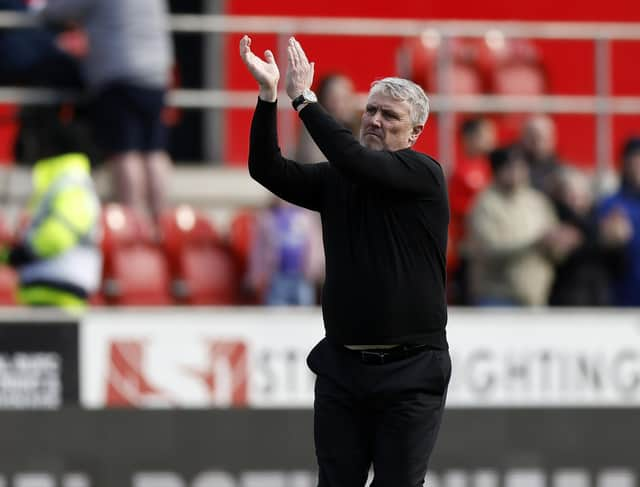

We knew Rotherham United were going down.
Clark hadn't held a boss's job in the EFL for almost a decade. Yesterday's man maybe, also a proper football man with a strong CV as a player, coach and manager.
He knew, really, that 27 points was impossible. He also knew that his mission in his nine-game tenure following the sacking of Matt Hamshaw was to lift spirits, to spark an improvement, to give supporters something to cling to, to make a case for him being offered a seat in the dugout beyond the end of a miserable relegation campaign.
Beyond the end of a miserable three years for anyone who has the Millers in their heart.
Rotherham kicked off the 2023/24 campaign in the Championship. They'll begin 2026/27 in League Two.
Last summer, Hamshaw was the local lad charged with leading a revival. He'd enjoyed promotions at AESSEAL New York Stadium as a coach under Paul Warne and now it was his turn in the hot-seat.
But he was hamstrung. Hamstrung by inheriting too many players he didn't want who were taking up too much of the budget. Hamstrung by an injury situation that his successor took less than a month to brand the worst he'd ever experienced in more than 30 years in the game.
And ‘hamstrung’ is the right word. Hamstrings were the most common ailment of all as the number of soft-tissue issues mounted and mounted.
For a while, Rotherham overcame adversity. They went through October unbeaten and did the same in November, but then followed dismal December and the tone was set for a slide down the table. The Millers didn't win again in the league until late January.
By then, members of the club's hierarchy were expressing doubts. There'd been too many bosses in too few years, but, now, the feeling was that yet another one might be needed.
As early as the New Year's Day loss to Peterborough United, Hamshaw was under threat. Several enquiries were made, no-one fancied the job. Rotherham's reputation as a firing club, the smaller budget, the place in the drop zone and the revelations about the lack of resources at Roundwood saw to that.
Just one full-time physio and one on a 'freelance' contract who wasn't paid to work on matchdays wasn't a good look.
Defeat to Peterborough brought the first whispers. Another loss to Posh - this time a heavy one at their place on March 17 - signalled Hamshaw's end.
A day later, Clark was at the helm. He had a testing introduction when much of his unveiling press conference was taken up by chief operating officer Paul Douglas trying to put a positive spin on the club's plight, but it was nowhere near as testing as his opening run of games: LDLLL and relegation spiritlessly confirmed with that fourth ‘L’ at Wigan Athletic.
Managers are only as good as the recruitment, a recruitment team is only as good as the budget.
The spending power wasn't as great as in previous seasons. 13 players arrived in the summer, none for upfront fees, and six more would come through the door in the new year.
The January window was cost neutral, with Rotherham spending on wages what they'd saved in loanees returning to parent clubs and Sean Raggett heading to Cambridge United for the rest of the season. It helped that Manchester United and Aston Villa respectively agreed to cover all the costs of Gabriele Biancheri and Lino Sousa moving to New York.
Clark came in and made an impression. There was none of the dourness that had characterised his best-known managerial reign, at Huddersfield Town between 2008 and 2012.
The Geordie has been engaged and friendly. Above that, he’s been honest. Above that, he’s been committed. He’s wanted to make the most of an opportunity he hadn't been expecting.
He’s been a savvy media operator, knowing when to hit fast-forward on criticism and when to press pause. He publicly went for the players twice, in the aftermath of a spineless derby loss to Barnsley and the equally insipid display at the Brick Community Stadium that made the drop mathematically certain.
Fans liked him for it. For too long, they'd watched a team that was too tame to fight and too accepting of its fate.
He won even more respect for criss-crossing the country to be with his partner in Newcastle and then with his squad in East London for the win at Orient only hours after the death of his mother-in-law.
With the season just about over, he waits to hear if he will be kept on at a worrying uncertain time for the club. He has already warned of the National League if changes aren't made to stop the rot.
Chairman Tony Stewart has presided over arguably the best period in Rotherham's history but is at an age where he may be reassessing his priorities, and events on his watch since 2024 might have persuaded him to firm up his exit strategy, particularly with potential takeover interest from a Swiss-fronted group.
The Millers have been drifting in the wrong direction for too long. Matt Taylor didn't work, Leam Richardson didn't last, Steve Evans, by his own admission, got it wrong, Matt Hamshaw couldn't mould old and young into something durable and worthwhile.
All failed for different reasons, all are different kinds of managers. Oh, for the six-season stability of Warne.
As urgent as anything is repairing the fractured relationship between club and supporters that has seen more empty seats than occupied ones at New York as season-ticket-holders have made their protest via their absence.
The Millers are now braced for a third major rebuild in three years. That smacks of poor planning or too little planning or no real planning at all.
Meanwhile, 27 from 27 has, with one game left, turned out to be just five from 24, but Clark has done himself no harm.
If he leaves, he'll go with fans' best wishes. If he stays, he'll be welcomed by a larger proportion of them than when he was Hamshaw's surprise short-term successor.
In unworkable circumstances, he's done what he could.