
The search for Rotherham’s Don Corleone
The search for Rotherham’s Don Corleone
In the aftermath of the General Strike in 1926 coal owners attempted to force wages down.

At Thurcroft Colliery industrial action recommenced which occasioned a threat that the pit would be closed down.
On Nottingham Street for Tommy Grice, a Thurcroft miner recently married to Catherine McNamara and with a young child, the future was looking somewhat bleak.
He was living with his in laws. A family conference was called.
Tommy had been brought up with the Stockdale family who were grocers, so he had some familiarity with the trade. But a different career would require some capital which the family did not have.
In all probability it was Thomas’s mother-in-law, Eta, that suggested that a local man, Sammy Moreton, for whom she did occasional work, might be able to help.
The family approached Sammy for a loan and used it to buy a handcart which Tommy pushed to the Sheffield wholesale market every day to hawk fruit and vegetables back in Rotherham.
It certainly worked and by 1927, he was running his own fruit and vegetable shop on Cavendish Street at Holmes, founding the Grice angling business familiar to generations of fishing fans throughout the town.
It was a risky venture, because what the family were aware of was that Sammy ran a protection racket in and around Frederick Street and Effingham Street.
Failure to repay the loan would have had consequences – and not in court.
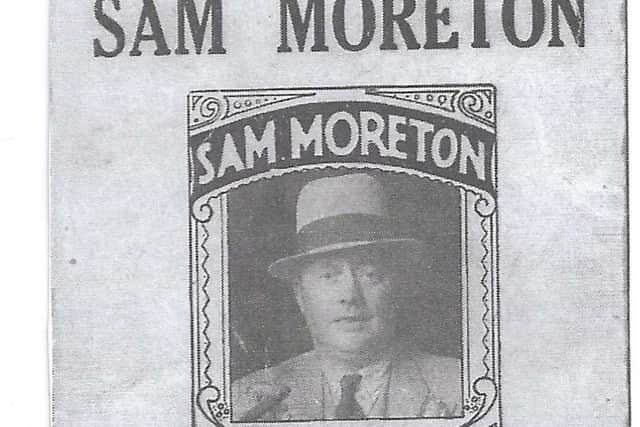
Ten years later, the Sheffield Independent described Samuel Moreton as a successful businessman and sports promoter and a Whiston parish councillor.
So which view is correct?
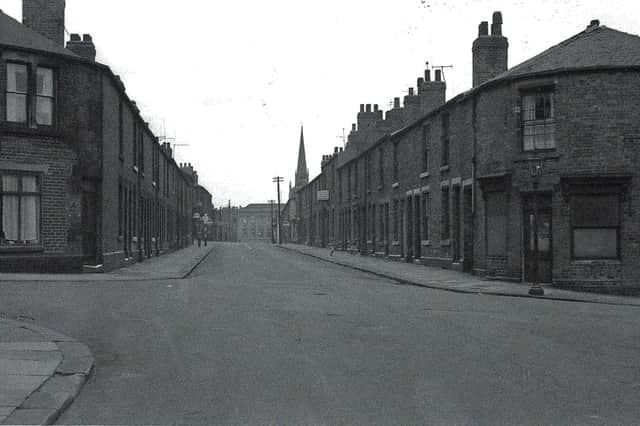
Sammy Moreton was born in 1896 and by 1901 was living in Lyndhurst Place just off Shaftesbury Square, which along with Truro Place, was still in the 1950s to be avoided.
By 1911 he had already gone down the pit but found it uncongenial and by 1913 could be found at Wombwell trying to sell dead rabbits that were unfit for consumption.
Having been fined he did not return to the pit.
Two years later he was fined 20/- for playing Pitch and Toss on Water Lane and causing wilful damage to the house of Catherine Rawlings which brought a further 30/- fine.
When the First World War broke out all able-bodied men were required to register for war service.
Sammy registered as a miner thereby avoiding conscription.
By 1916 Sammy was well-known to the authorities. Police sergeant Smith, knowing he had not been a miner for a number of years, arrested him, for fraudulent registration.
He was fined 40/- before being turned over to the army.
His army career was hardly commendable.
In that year he had married Ann Roddis and sired a daughter Lily.
Fatherhood did not lead to a change of behaviour.
In 1920 he and a gang assaulted William Webb, a steelworker, for which he was fined £5.
Worse was to follow that year when he was in court for receiving stolen jewellery from Horace Abell, being the proceeds of a burglary at Whittaker’s Pawn Shop.
By now the police were saying that he had been a great trouble to them for a considerable time.
At this stage he had 11 convictions.
Whether it was for this offence, or running a “Find The Lady” scam at Southwell races where he was charged with theft from one of his victims, is not clear but he received two months hard labour.
Also in 1921 he was found guilty of theft of £2 from George Harvey, manager of Charlton Ironworks at Doncaster Station. He spent 1921 census day in Hull prison.
For the next three years he operated as a bookie’s tout, though in 1924, he was to earn a three month sentence for pickpocketing at a Lincolnshire racecourse.
His proclivity for violence found him in court again, in 1927, charged with assaulting an Attercliffe hawker.
He was found not guilty because none of the witnesses were able to recognise him.
This was a recurring story.
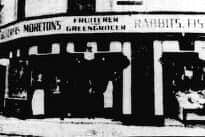
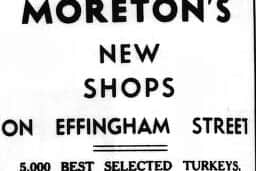
Sammy opened a shop on Effingham Street in the late 1920s.
However even here he found himself in court again being fined 40/- for carrying his business on after hours from a motor lorry.
Though he continued being active on the racecourse, he was now looking to establish himself as a fruitier on Effingham Street.
Clearly, old habits die hard as in 1928 he, together with Samuel Draycott, was found guilty of receiving 10,000 cigarettes.
Draycott was a long time associate of Moreton.
Sammy was given four months and Draycott three months.
Horace Hazelhurst was involved with the court case much to the annoyance of some of Moreton’s employees who decided to vent their displeasure on Horace and handed out a thrashing.
In Eastwood, Percy Hacket, Sam Spittle and Ernest Harland, who had assaulted Horace, called themselves Moreton’s Megranes, an old term for migraines, implying that they could deliver headaches on Moreton’s behalf.
They were clearly identified as being part of a gang.
Charges of assault continued to be made against Sammy, but remarkably the witnesses could not recognise the assailant as they were too far away!
It seems that Sammy may have seen a need for more respectability.
The shop on Effingham Street appears to have been doing well so he entered the field of boxing and wrestling promotion, firstly at Parkgate Miners Welfare and then in town.
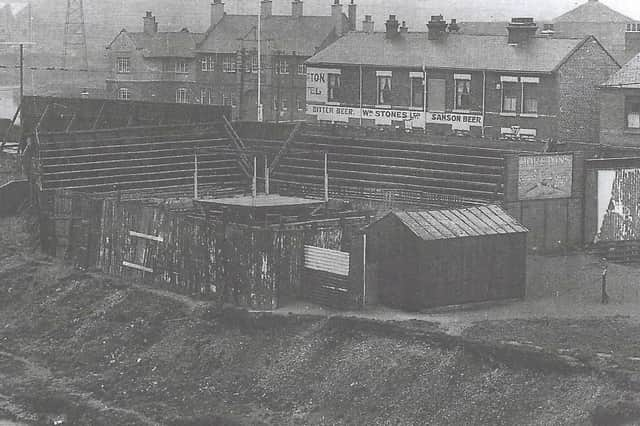
In 1932 he built the Effingham Stadium situated roughly where the Leisure Centre now stands and did appear to have a talent for promotion.
Bouts were popular and the press commented on the quality of the programmes.
Though it begs the question as to where the finance came from.
When he chose to expand to Sheffield the police objected to the application.
By 1935 the affluent businessman had moved to Whiston where he decided to build a club for the residents.
Named after Lord Lonsdale of boxing fame, it opened in August 1935, built at a cost of £5,000 by T W Outram.
It was opened by the respected Edward Dunn MP in the presence of other dignitaries, including Leslie Tarbitt, the well-known barber and councillor, and the builder T W Outram, both of whom grew up in Eastwood.
It is difficult to believe that in the close knit community around St Anns Road, Outram and Tarbitt would not have been familiar with his reputation.
Conversations with the sons of that generation reported that their fathers knew Sammy as a gangster, a bookies runner and a flyboy.
The police certainly were aware and 16 police officers raided the club in November.
The club was run by his wife and daughter Lily who both received fines and its licence was suspended.
Sammy was the owner and received 7/6d a week rent but was not liable for the running of the club.
During the trial a lawyer asked him was it not the case that he went everywhere with a bodyguard, to which he responded that he employed 30 men.
One of those, Gustave Salmon of Tusmore Street, who had previously had a case of attempted murder dismissed, was a trustee of the club.
The outbreak of war presented more challenges with the imposition of food rationing in 1940.
In 1944 Sammy again escaped prison when he was once more charged with receiving.
A necklace stolen from the venerable politician David Lloyd George was found in his possession by Inspector Scott.
Oliver Mason, the jeweller, valued it at around £250.
Sammy claimed that he had exchanged it for a diamond ring at a race meeting.
He said that he would recognise him if he saw him again but did not know his name.
As a charge of receiving required that the receiver knew the item was stolen the magistrate said there was insufficient evidence to convict.
Sam Moreton’s reprieve did not last long.
In the September of 1945 he was charged with conspiracy to obtain food by illegal buying, namely over 30,000 lbs of strawberries.
Salmon was again involved.
Also charged was Tony Kent of Wortley Road, who when asked whether he owed Moreton money, he replied probably, but that he had been very kind to him!
Sammy owned the property on Wortley Road where Kent lived.
Moreton was given three years’ penal servitude and fined £300.
He closed the grocery business in 1951.
He moved to Blackpool, an intention long in the offing, where he had purchased a residential hotel, a restaurant and a seaside rock company as well as a residential hotel at Newton.
He returned to Rotherham in 1960 when Ann died.
When he passed away in 1969 the Advertiser carried a very flattering obituary of him referring to him as a Rotherham philanthropist.
Never a mention of his illegal activities!
- Edited by Julia Brammer