
Innovator, alchemist and champion: Herbert Chapman celebrated by blue plaque in his home village of Kiveton
A MAN with a claim to being “the greatest British football manager of all time” has been honoured with a blue plaque in the village where he was born.
Herbert Chapman twice won the old First Division with Huddersfield Town and Arsenal as well as the FA Cup with both, in doing so carving out a reputation as one of the game’s great innovators.
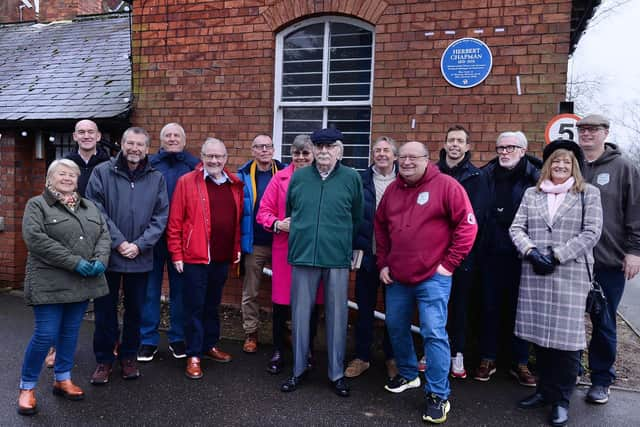
His longest surviving relative, Ken Chapman, was among the guests as the plaque was unveiled at the old colliery offices at Kiveton, just a stone’s throw from where Herbert grew up.
The gathering heard the story of a bright football thinker who made a big stamp on the domestic game in the 1920s and 1930s.

"There is a strong case for arguing that Herbert Chapman is the greatest British manager of all time,” said local football historian John Stocks.
"He won successive, back-to-back league titles with Huddersfield Town. Then he moved to Arsenal and won two more.
"The great Sir Alex Ferguson won more titles at Manchester United but had the benefit of living a lot longer and also he was standing on the shoulders of giants. He was following on from people like Sir Matt Busby and he was working at a great institution.
"Herbert Chapman was an alchemist. He turned base metal into gold, both at Huddersfield and at Arsenal.”

The blue plaque is a joint venture between the Kiveton Park and Wales Historical Society and the recently established charity, Sheffield: Home of Football.
It has been funded by Steve Hann, a lifelong Arsenal fan got in touch with the charity and offered sponsorship.
The Gunner was told that Arsenal and London football in general owed Herbert Chapman a huge debt.
"Huddersfield were developing as a club but going nowhere until Herbert Chapman joined them,” added Mr Stocks, continuing the Chapman story.

"’Similarly, Arsenal were floundering, really struggling. Herbert created the modern idea of Arsenal. The football club was inspired by his vision.
"Not only that, the whole of London football was on its knees at the time. Spurs had won a couple of FA Cups but mainly with players from the north and midlands.
"Nobody had won the league championship (from the capital). They were in thrall to the football powerhouses of the north and the midlands, so Herbert really created London football.
"Off the pitch, he was a micro manager, from putting the white sleeves on the Arsenal kit to white shorts to popularising the white ball and getting the tube station next to the ground called Arsenal in honour of the football club. These were great innovations.
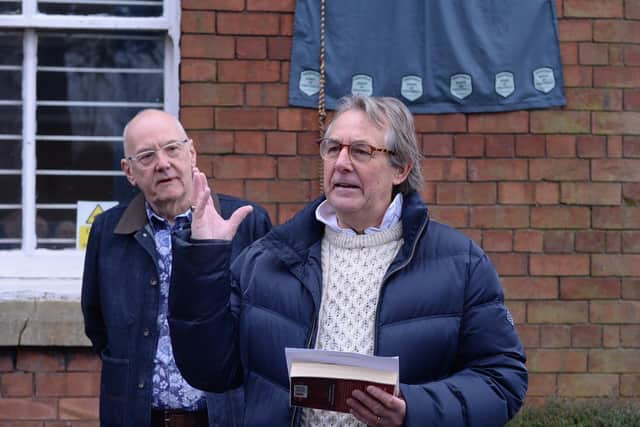
"He also developed links with European clubs. He studied European football and would almost certainly have won European cups if he had the opportunity. If he had lived longer he would certainly have won more league titles as well.”
Chapman had only a modest playing career, including time with Kiveton Park FC, but his ability as a manager shone through with Northampton Town and Leeds City before he really flew, first at Huddersfield from 1921-1925 and then at Arsenal through until his sudden death from pneumonia in 1934. He was still only 55.
A bright tactician, Chapman was ahead of his time, establishing a playing system that can be traced right through to the modern-day game and the recent successes of Pep Guardiola’s Manchester City.
"As a tactical innovator, Herbert was inspirational,” said Mr Spacey.
"Inverting the pyramid, the 3-2-2-3 tactical transformation, was credited to Herbert Chapman. He didn’t invent it but he certainly popularised it.
"It was arguably the greatest tactical innovation in football history, certainly in the 20th century.
"The basic strategy was to drop a centre-back, a third person in defence, and to have inside forwards coming back as well as being flexible.
"That style was still being deployed by Manchester City pretty much when they won the treble recently.
"It is important because it unlocked counter attacking potential and without that invention we wouldn’t have the great Brazilian team of Pele and Rivelino.
“We wouldn’t have Cruyff and the great Holland team. They wouldn't have been able to operate without that innovation.”
Alongside Brian Clough and Kenny Dalglish, Chapman is one of only three managers to win the First Division with more than one club.
His legacy lives on, shown when Mr Stocks recently travelled down to Hendon on the 100th anniversary of Herbert Chapman joining Arsenal, joining locals as we as members of the Arsenal Independent Supporters Association.
"They said he wasn’t just a great football manager. He was a great man,” recalled Mr Stocks.
"The vicar who gave the address said that on the morning after an FA Cup final win or a championship triumph Herbert could be seen handing out hymn books in the parish church.
"They are incredibly proud of him there. His grave is revered. It is tended every year by Arsenal supporters. He was also a great friend to the Jewish community in that area.”
The historian added: “I’m steeped in this community. My grandad was a face worker at Kiveton Colliery. My dad worked at Kiveton. I’m incredibly proud of Herbert Chapman.”
The Chapman family name is already commemorated at Chapman Fields, the modern 4G facility at Wales High School.
Right next to where the new plaque will stand is another 21st century football facility, named in Herbert’s honour.
Before the latest tribute was unveiled by Ken Chapman in the presence of his daughter, Kay Dulley, there were a few laughs when Jake Richards admitted he was a fan of Arsenal’s great rival, Spurs.
But the MP is keen that there is a positive legacy from Herbert Chapman’s achievements.
“We are talking about the past but here we have the future,” he said. “We have incredible facilities in the heart of Kiveton and at Wales High School.
"Just recently I had a meeting with the Football Foundation about an exciting initiative to build more 4G pitches across Rotherham and as a local MP I am determined to play my part in doing so.
"While it is good to remember the heroes the past, we have to make sure kids have the facilities to help create the Herbert Chapmans of the future.”
ALTHOUGH Herbert Chapman was Kiveton Park’s most famous son, his family also left a huge mark on the old pit village.
Herbert’s younger brother, Harry, played for Sheffield Wednesday, winning two League One championships. He got his hands on the FA Cup in 1907 and scored in the final, collecting the Man of the Match award.
Elder brother John was the parish chairman and the head of the union at the pit.
"The day that John died every shop in the village closed and the pit shut for a while,” explained John Spacie, chairman of Kiveton Park and Wales Historical Society, at the unveiling of the blue plaque in honour of one-time Huddersfield Town and Arsenal manager Herbert Chapman.
"That shows how important the Chapman family have been to this area.”
Mr Spacie also has a personal link with the family.
“Herbert was my dad’s godfather, so I always knew about him,” he said. “My dad was an Arsenal fan.
“Herbert of course died in the 1930s, so it was great when ten years or so back when his name started being mentioned again.”
Also among among the guests at the ceremony were ex top-flight referee Keith Hackett, former Minister of Sport Richard Caborn, Jake Richards MP and Andy Booth, ambassador for Huddersfield Town.