
Horatio Nelson: Rotherham-made cannon which saw legendary admiral to his greatest victory at Battle of Trafalgar
ON October 21 1805 the British fleet of 27 ships of the line led by Horatio Nelson on HMS Victory met the 33 ships of the combined French and Spanish fleets off Cape Trafalgar and won a stunning victory.
They sank 18 ships with losses of nearly 4,000 men while losing just one British ship with a loss of 58 men.
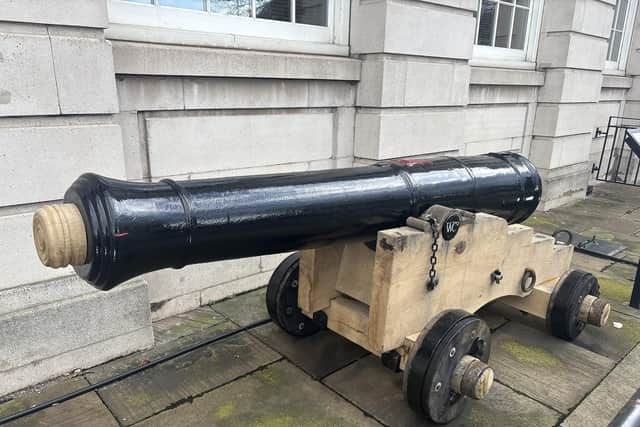

That they were able to do so was down to Nelson’s tactics and the superior gunnery of the British ships. His flagship, HMS Victory, was armed with high quality ordnance most of which was created at the Walker Ironworks in Masbrough.
That the town is fortunate to have a memento is down to Don Scott, at the time the Curator of the military museum in Clifton Museum. With his interest in the town’s heritage he became aware of the role of the Walkers in our nation’s history and embarked on a personal quest to find and bring to the town an original Walker Cannon.
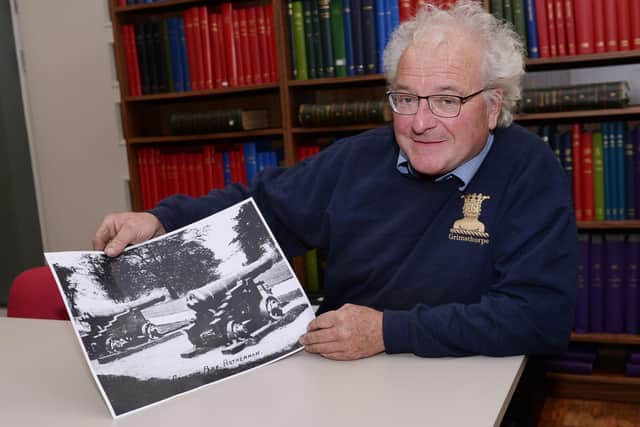
His journey, in the early 1990s took him down to the Chatham Dockyard Museum where he was shown many Walker cannons but was unable to persuade them to release one. However, a member of staff, Adrian Caruana offered his help. He located an Irish scrap merchant who identified a Walker cannon in a scrapyard in Kent. Armed with a low loader a purchase was arranged and the cannon came to Rotherham.
It is not surprising that over time the condition would deteriorate. In a rare appreciation of the town’s heritage Rotherham Council staff contracted Andrew Renwick, a specialist heritage blacksmith of Ridgeway Forge at Attercliffe, to refurbish the cannon.
Mr Renwick’s renovation of the modest nine-pounder has also included the gun carriage. Sea born cannons were required to have wheels for securing in heavy seas. As the gunners would have slept by the guns it was also useful in avoiding them from being run over!
What of the Walkers and their Rotherham Ironworks which stretched from the Holmes to what is now the Pool Green roundabout on the inner bypass with other establishments further down river?
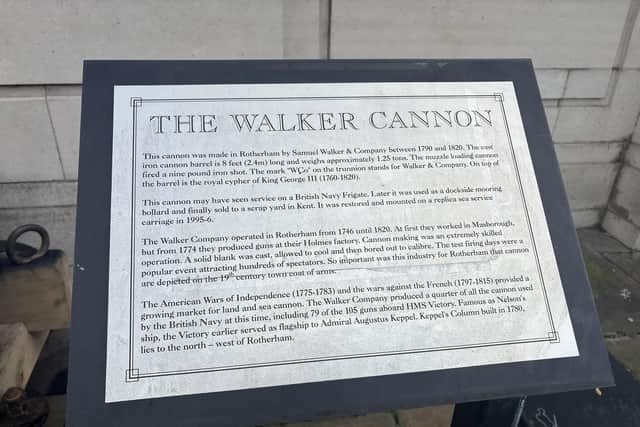
As a company they were commercially nimble, quickly learning from others such as “Iron mad” Wilkinson who developed a method in 1774 for boring canons from solid pieces. At the same time the Walkers were moving into cannon production which turned out to be a prescient decision as, shortly afterwards, the government formed a Board of Ordnance.
They quickly demanded that cannon be cast solid and then bored out as there had been too many exploding cannons under the previous technology. To test them they used an earthen bank at Jordan just below Meadowbank Road. One old Fairbank’s map records two fields being called Gun Flatt.
To develop the new way of production the Walkers co-operated with Thomas Blomfield, the Inspector of Artillery, to improve the guns by making them lighter and strengthening the breeches and in 1786 received a government contract to deliver 1,000 guns to Woolwich Arsenal by December 1787. Their brand became symbolic of the superiority of their product with over 13,000 guns to the government.
That their reputation was growing beyond Great Britain is evident when Tom Paine came to study the Walker techniques in bridge building. He spent six months in 1788 studying at the Walker Ironworks. One Rotherham resident a generation later says that he lived at Holmes Hall. Paine provided the intellectual arguments that underpinned the making of the American Constitution with a later President saying that history would ascribe the American Revolution to Thomas Paine.
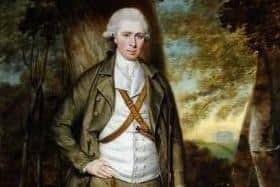
While at the Holmes, Paine wrote to his friend, Thomas Jefferson, one of the Founding Fathers, informing him that the Walker Iron Works were the most eminent in England and its owners had great energy as well as great wealth.
The navy used large number of Walker cannons during the Napoleonic Wars and one of the ships that received them was Nelson’s flagship, HMS Victory. Walker cannons can still be seen today on HMS Victory in Portsmouth. The victory at Trafalgar was underscored by superior gunnery thanks to the Holmes Works.
The Walker brothers and their offspring were astute businessmen. It can be confusing as the name Samuel descends down the generations. What was clear is that they built a sophisticated commercial operation which reflected on the fact that they became virtually a conglomerate with varying interests across the country.
Their answer to acquiring finance for expansion was simple. They formed their own bank!
Walker, Eyre and Stanley Bank opened its doors on January 1 1802. Samuel of Masbrough House, Joshua of Clifton House and Joseph of Eastwood House partnered with Vincent Eyre, the Duke of Norfolk’s Agent and William Stanley to establish the bank which, in years to come, was to become William Deacons bank.
The Old Bank at the bottom of High Street was the original site of the Walker Bank. By then they were exporting their technology across the world.
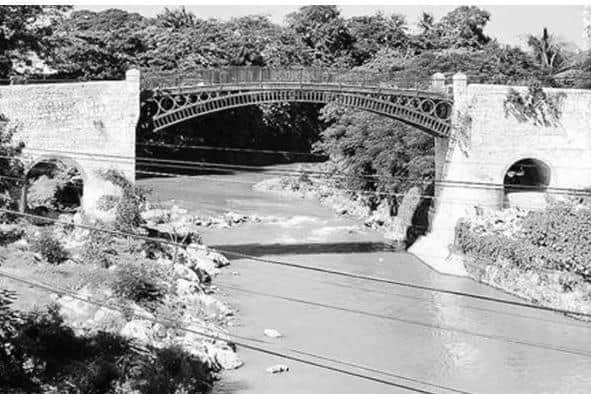
At the end of the Seventeenth century the Jamaican Assembly decided to build a bridge over the Rio Corbo to link Kingston and Spanish Town.
They approached a Durham Engineer, Thomas Wilson, to design the new bridge. His design being accepted he commissioned the prefabricated parts from the Rotherham Ironworks by now known as Joshua Walker and Co.
The parts were shipped to Jamaica and constructed by 1802. Undoubtedly the actual construction would have been done with slave labour. Today it is one of the only two Walker Bridges still existing and is a Jamaican national monument.
As contractors to the government, it was wise to seek some political influence in London. They did this by paying around £3 million to buy Aldeburgh a “rotten borough” in Norfolk. It was a small fortune at the time but gave Samuel’s grandchildren Joshua and Samuel seats in Parliament.
There they supported radical legislation voting to repeal the Test Acts which discriminated against Roman Catholics and signing a petition calling for the abolition of the slave trade. Joseph at Eastwood House was a friend of William Wilberforce who visited Eastwood.
It appears that Joshua was the politician in the family as he remained in London living in a desirable property, Hendon House, near Hampstead Heath. He remained in Parliament until 1829 by which time he was living at Red Bull Wharf on the Thames, which he owned in partnership with other family members and relatives. Despite having the Walker liberal instinct he never the less became Chair of the Brazilian Mining Association who were still using slaves on their properties.
Joshua went on to be the force behind the setting up of the Great Junction Railway from Birmingham to Manchester along a route which is now being followed by the HS2 planners.
When the Walkers began to wind up their Rotherham business around 1823, Samuel Walker III along with William Yates, took over a factory in Gospel Oak in Tipton Staffordshire removing the cannon machinery from the Holmes to Staffordshire. They continued to make and sell cannons until the 1850s. This particular factory also produced the iron supports in Liverpool’s Albert dock.
By 1800 they had an export office in that city and Joseph Need Walker was building Calderstones Mansion and a major commercial figure in the city. On his death the Mansion was sold to the founder of the Cunard line.
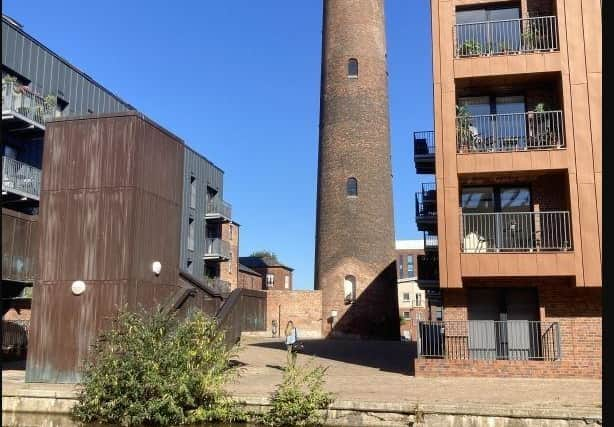
They were quick to diversify entering the lead industry. At Elswick in Newcastle they established a lead works as they did in Chester. Both these factories had shot towers for the production of munitions.
Although the Elswick works in Newcastle have disappeared under redevelopment the Chester authorities have incorporated their historic shot tower in an innovative housing development which includes a modern art installation entitled Mr Walker!
In the years that followed the Walker family dug themselves deep into the infrastructure of the British economy and continued to innovate and invest into new technologies.
Is it not sad that that one of the greatest industrial conglomerates of the Georgian and Victorian years that was founded in Rotherham is celebrated in the town of its birth with a small mausoleum that is shuttered up in Masbrough and a single cannon, while one of its products is celebrated as a national monument in Jamaica?
Walker’s Cannons at Trafalgar are, according to Andrew Renwick a memory of the prowess of Rotherham’s engineering heritage which should be sung from the hill tops with immense pride in the town.
Our MP Sarah Champion will join with Andrew Renwick in an event to celebrate the return of the cannon to its place outside the Town Hall at 2.30pm on Friday November 21.
Edited by Julia Brammer