
Growth Britain: John Healey steps out from Reeves's shadow
Rotherham MP John Healey showed a difference version of himself with first major speech as Chancellor
John Healey has never been the sort of politician who makes you wonder what he is going to say or do next. His appeal has generally been rooted in steadiness rather than showmanship.
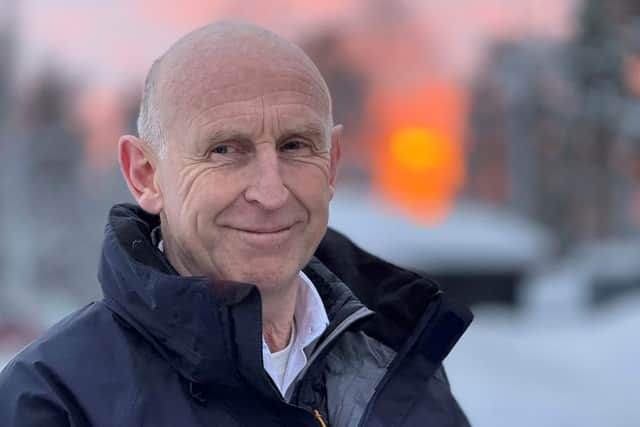

At 66, and after nearly three decades representing the South Yorkshire area, he is an experienced, serious politician who looks as though he has read the briefing and knows where the awkward questions are likely to come from.
So it was interesting to watch him on Monday morning trying on a rather different version of himself.
At the Manufacturing Technology Centre in Coventry, the relatively new Chancellor was plainly determined to sound upbeat.
This was to be the speech about the future rather than the past, about what Britain might become rather than another recital of what he had inherited. The Rawmarsh and Conisbrough MP talked about optimism, innovation, wealth creation and the opportunities presented by new technology, and produced the phrase which will probably stick to him: his mission is to “make Great Britain, Growth Britain again”.
It is a slightly awkward construction, but you could see what he was doing.
There was more warmth in Healey than there often is when he is addressing the Commons.
He smiled, looked around the room and seemed most at ease when talking about the people actually working at the centre.
He began with a little exchange on the way into the building, asking 'Graham from the MTC' what he was most proud of. The answer was that they turn small ideas into brilliant businesses.
Healey picked up the phrase and used it to explain why he wanted government to be on the side of companies trying to grow.
It was probably the most convincing part of the performance because it sounded like something he had actually heard rather than something a speechwriter had handed him.
There was also a distinctly northern thread running through the presentation.
The £150 million Northern scale-up fund and the new “Northern 500” scheme were designed to put some substance behind his argument that growth needs to happen in more places, rather than being concentrated in a handful of major economic centres.
But if Healey was trying to establish his own voice, he was doing it while standing on ground that is not entirely his own.
Much of the economic prescription, growth, deregulation, regional investment and fiscal discipline, is a continuation of the approach taken by Rachel Reeves and Keir Starmer.
Reuters made much the same point, describing the speech as a brighter vision but noting the continuity with his predecessors.
The difference is principally in the presentation.
Reeves tended to dwell on the difficult inheritance; Healey is trying to tell what he described as a new, optimistic story about Britain.
That distinction may become rather important.
Healey is going to have to sell an optimistic story while preparing what could be a decidedly uncomfortable Budget.
He was careful to repeat his commitment to fiscal discipline and to meeting the Government's financial rules, while refusing to be drawn on the tax decisions which will be announced on October 28.
Reuters described him as walking a tightrope, with markets watching closely for evidence that the Government can combine Burnham's ambitions with financial discipline.
His opponents were predictably unimpressed.
Conservative shadow chancellor Andrew Griffith accused him of sounding like 'continuity Rachel Reeves', arguing that warm words about growth would not make growth a reality. Reform's Treasury spokesman Robert Jenrick was less diplomatic, describing the speech as 'dire and dreary'.
There is an element of political knockabout in that, but there is a genuine question underneath it: how much of this is actually new?
The most striking difference is perhaps not economic at all.
It is presentational. Healey is clearly trying to present himself as a Chancellor who actually likes business and believes Britain can get richer, rather than simply as the man responsible for keeping the Treasury's books in order.
Whether he can pull that off remains to be seen.
And then there is his boss, Andy Burnham.
The comparison is unavoidable because Burnham made his first appearance in the Commons as Prime Minister last week.
Burnham is a more instinctive political performer. His first Commons statement was expansive and rhetorical, and his subsequent PMQs appearance reinforced the impression of a politician who is extremely comfortable in the theatre of Westminster.
Healey is different. He is more deliberate, more grounded and less obviously theatrical. He does not quite command a room in the Burnham fashion; he works his way into it.
That may actually suit the job.
The Chancellor's speech was not a barnstorming political address. It was an attempt to establish a mood: Britain has been through a difficult period, government needs to stop getting in the way, and the next phase should be about investment, innovation and jobs.
His promise to take an “axe” to the “thicket” of consultation, litigation and administration, speeding up investment. That gave the speech its strongest edge.
The trouble is that “Growth Britain” is still only a phrase until somebody can point to the growth.
And Healey had an awkward reminder of the challenge while he was speaking.
Jaguar Land Rover announced plans to cut around 4,000 jobs globally over the next two years, with the news landing against the backdrop of a speech about rebuilding British industry and spreading prosperity beyond the major cities.
Reuters reported that Healey said the announcement underlined the need for a broader growth strategy.
It was a good political answer.
Now he has to make it a good economic one.