


Sheffield Crown Court has bore witness to details of some of the worst, and most shocking, crimes in South Yorkshire’s history since it opened almost exactly 30 years ago.
After being officially opened by the then Lord Chief Justice of England and Wales, Lord Taylor, on May 17, 1996, thousands upon thousands of criminal court cases have been heard inside the imposing building on West Bar in Sheffield city centre.
Judges have dispensed justice in cases involving criminals convicted of some of the most serious offences on the statute book, the circumstances of which have left people across the county - and indeed the country - in utter disbelief.
Thousands of jury panels have also presided over trials heard at the court, after defendants entered not guilty pleas, triggering the centuries-old right for a case to be heard by a dozen of their peers.
A long line of Star court reporters have also been present in court, furiously noting down every cough and splutter from the press bench, in a bid to be your eyes and ears as cases are heard.
From the pre-internet days when court reporters would dictate copy to the newsroom over a landline telephone, through to providing updates in real time through social media and online blogs, to the months when people were required to stay at home during the Covid-19 pandemic, The Star has been there every step of the way throughout Sheffield Crown Court’s 30-year history.
Court reporting continues to play an important role in open justice; and the principle that “not only must justice be done, justice must be seen to be done,” which was coined more than a century ago by Lord Hewart, the then Lord Chief Justice of England.
The former Sheffield Crown Court building, which was also known as Sheffield Old Town Hall, on Waingate, opposite Castle Market, still stands disused following the move to the new law centre on West Bar. The most recent update in the Grade II listed building’s history came in November 2025, when it failed to sell at auction.
Here, we have delved into The Star’s archives to bring you this collection of the biggest, and most high-profile, cases heard at Sheffield Crown Court over the last three decades.
In this first part, we take a look at cases heard in the first 15 years that have passed since the Crown Court was opened, running from May 1996 through to May 2011.
Below are links to more detailed reports on the cases included within this article:
- Heartbreaking case of vulnerable Sheffield teen murdered by friends armed with farming scythes on camping trip
- Shoe rapist James Lloyd's chilling confession when South Yorkshire Police uncovered his crimes
- Edlington torture brothers: Why pair who tortured and nearly killed two young boys can never be named
- Burngreave crime: The killers who rapped in court after teenage boy was shot dead in city street
- David and Ashley Cohen: Sheffield brothers spend 15 years behind bars for murder they deny
- Jonathan Matondo: The unsolved murder of teenage boy gunned down in Sheffield
- How detectives solved 'body in the bag' murder after remains found in Sheffield
- Gerald Smith: 20 years since nine men were jailed for Sheffield murder after trial that made legal history
- Lester Divers: 20 years since notorious gangland killing which shocked Sheffield
- Sheffield dad dubbed "British Fritzl" made his daughters pregnant 19 times
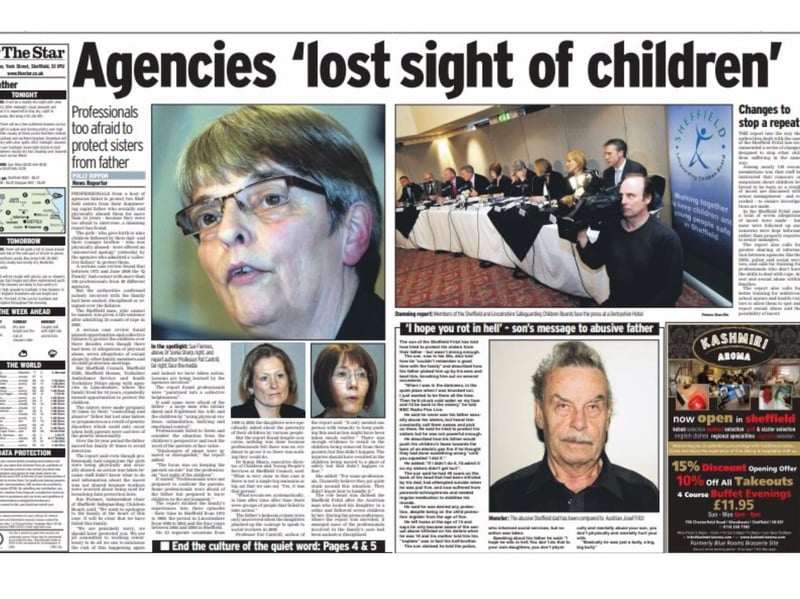
13. Sheffield Fritzl: Depraved man raped daughters over 25 years resulting in 19 pregnancies jailed in 2008
In November 2008, Sheffield’s most senior judge described a case in the city as “the worst” he had dealt with. It involved a dad who had raped his two daughters for over 25 years, resulting in 19 pregnancies. The women gave birth to seven children as a result of the sex attacks. The sisters were used as sex slaves by their father on an almost daily basis for decades, with their ordeals only coming to light when one of them told a social worker in 2008 and their dad was finally arrested. He was 56 when he was sentenced to 25 concurrent life sentences later that year after admitting 25 counts of rape. The rapist, who cannot be named for legal reasons, was ordered to serve a minimum of 19-and-a-half years behind bars before becoming eligible for parole. The rapist, who cannot be named for legal reasons, was ordered to serve a minimum of 19-and-a-half years behind bars before becoming eligible for parole. Sentencing the depraved rapist, Judge Alan Goldsack, said at the time: “I can say that in nearly 40 years of dealing with criminal cases and 14 as a family judge, the combination of aggravating circumstances here is the worst I have come across.” The horrific case in Sheffield came to light in the same year that Austrian Josef Fritzl was arrested for keeping his daughter locked in an underground cellar for 24 years and raping her thousands of times, fathering seven children. It led to the Sheffield dad being dubbed the “British Fritzl” because of the similarities. During his court case and investigations afterwards it emerged that the Sheffield dad’s family had contact with 28 different agencies and 100 members of staff over 35 years but despite concerns and suspicions no action was taken. The family also moved around 70 times over the years, and it is believed this was a deliberate ploy by the dad to hide his sex crimes. The abuse of the two sisters began when they were aged between eight and 10. They were beaten if they tried to prevent the sexual abuse | Iconic Media Group
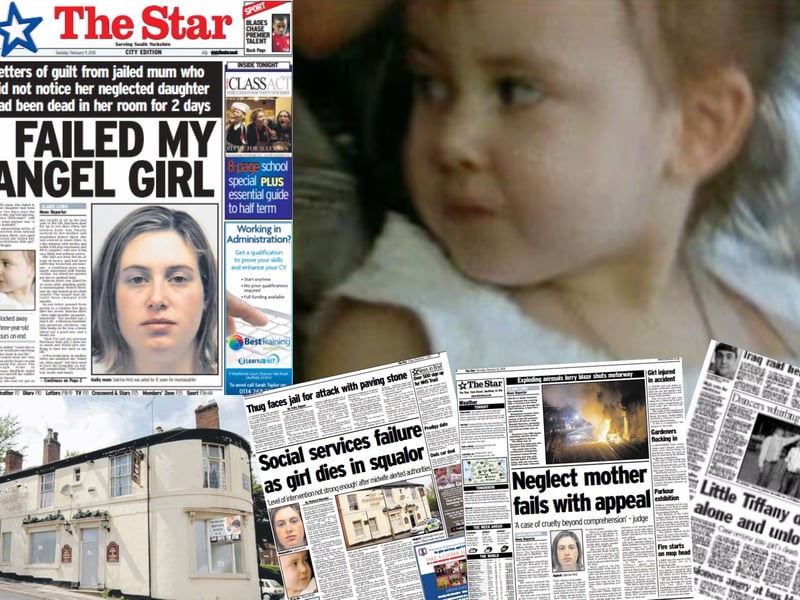
14. Neglect mum jailed in 2008 over child manslaughter of three-year-old Tiffany
When police and paramedics found the body of three-year-old Tiffany Wright she was so tiny and undernourished she was described as looking like a fragile ‘porcelain doll’. Shockingly, the blonde haired tot had been dead for at least two days before her mum and stepdad raised the alarm. An investigation into the circumstances surrounding Tiffany’s death, above a Sheffield pub, laid bare a heartbreakingly sad existance, where the little girl’s mum had cared more about her dogs than her own daughter. It was 2007 when Tiffany’s mum, Sabrina Hirst and stepdad, Robert Hirst, raised the alarm when discovering the frail tot’s lifeless body. The pair ran the Scarborough Arms pub in Upperthorpe together and CCTV cameras recorded conversations between the pair where they had discussed whether their dogs had been fed while little Tiffany was being starved to death. Tragic Tiffany’s body was covered in insect bites after suffering a 'prolonged period of malnutrition' and 'utter neglect,' a report into her death revealed. The family flat above the pub was found covered in dog faeces when it was examined after Tiffany’s death. Sheffield Crown Court heard the couple they had kept Tiffany in “squalor, filth and degradation” and “entirely neglected” her. Tests revealed Tiffany had not eaten or drunk anything for at least 20 hours before her body was found. Sabrina Hirst, who was 22 at the time of the court case into Tiffany’s death, was sentenced to 12 years after admitting manslaughter and child cruelty. It is thought that she only served four years of her sentence before she was freed. Her then 44-year-old husband admitted two counts of child cruelty and was jailed for five years. The sentencing judge, The Recorder of Sheffield, Alan Goldsack, expressed his surprise at the time that the Crown Prosecution Service had accepted Tiffany’s mum’s guilty plea to manslaughter when she was initially charged with murder. He described the case as “about as bad a case of child manslaughter as there can be” | 3rd party
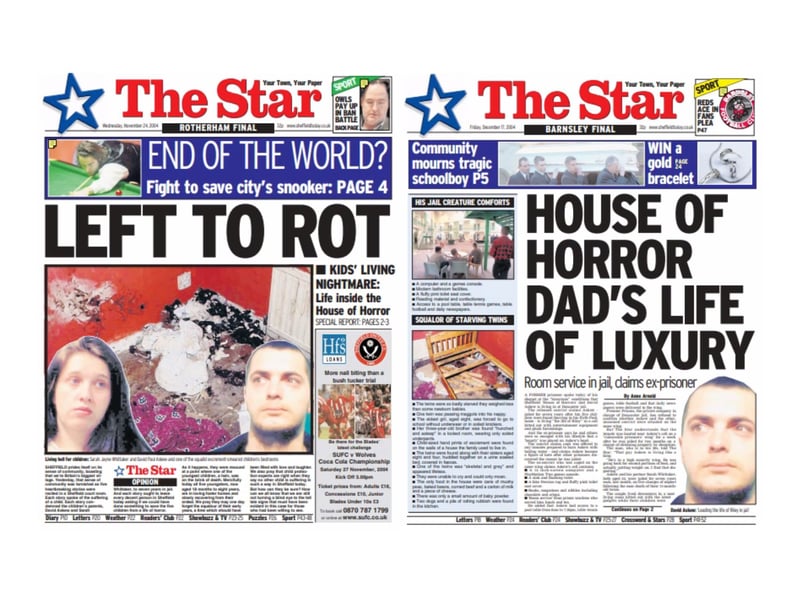
15. Sheffield couple jailed for starving children in 2004 in one of worst cases of malnutrition seen outside developing world
Five vulnerable young children were condemned to utter squalor by their parents in a Sheffield house of horrors. In 2004, parents Sarah Whittaker and David Askew, then both aged 24, were jailed seven years for their callous treatement of the children, including a baby who was left close to death. While Whittaker and Askew were enjoying all the luxuries of modern living, their children were living in squalor. A doctor who examined the children said it was the worst case of malnutrition he had even seen outside the developing world. Their critically ill one-year-old twins were found “within hours of death” at their home and three other children - aged three, four and seven - were living in squalor in excrement-smeared bedrooms. An official review into the case found mounting evidence about the state of the family was not recognised, resulting in an inability to properly assess their needs. o attend medical appointments for routine matters such as immunisations should also have triggered action, the review said. It also criticised the family’s health visitor, who was guilty of individual professional poor practice. The eldest child’s poor school attendance record led to visits by several professionals without sparking any concerns over wider neglect. The school itself should have recognised that the children were in a vulnerable position, despite the fact that the child was one of a number of youngsters in that situation | Iconic Media Group

16. Sheffield boxing legend's success came crashing down after conviction over near-fatal crash
Naseem Hamed, known as Prince Naseem and Naz during his days in the ring, walked into Brendan Ingle’s famous Wincobank gym as a seven-year-old boy and left as a champion and multi-millionaire. The famous gym in a former church hall was close to where Naz grew up in a flat above the convenience store his parents ran. Naz was one of nine siblings whose parents had come to the UK from Yemen and whose father initially worked at a steelworks in Sheffield before taking over the corner shop on Newman Road. Naz’s dad took him and one of his brothers to the gym because they were getting picked on at school – and the rest is history. Three world titles followed and multi-million pound paydays, which transformed his life while he fought between 1992 and 2002. His net worth is reportedly £50m. In his prime he was a global superstar, but his success came crashing down around him in 2005 when he was involved in a near-fatal crash on Ringinglow Road while driving his £320,000 at 90mph. He smashed head-on into another vehicle, leaving the driver with every major bone in his body broken, during an overtaking manoeuvre. In 2006, Naz received a 15 month custodial sentence and a four-year driving ban after pleading guilty to dangerous driving. Electronically tagged Naz was released from Moorland open prison in Doncaster after serving 16 weeks of his sentence. A stretch limo and a Rolls Royce laid on by friends and two brothers were waiting for the disgraced boxer as he walked out of the prison gates to regain his freedom. He punched the air and turned to wave at inmates he had served time with before saying how “hard” it had been and how he was thankful nobody had died. He missed the birth of one of his children while he was locked up. Naz was awarded the MBE in 1999 for services to boxing but was stripped of the honour following his driving conviction and subsequent jail sentence | Iconic Media Group