
Buy! Buy! Buy! How the Advertiser's ads were making us spend our money a century ago
NEWSPAPER advertisements these days have to follow strict rules concerning honesty, accuracy and legality.
A hundred years ago in the Rotherham Advertiser it would be fair to say that things were somewhat different and that the topic of advertising had something of the Wild West about it.
Frankly, you could probably get away with saying anything, making wild claims on health issues and flogging often dodgy merchandise (by our standards today).
But they were different times and a look back can be amusing and/or downright frightening.

You can also see the issues which were playing on people’s minds, and which desires advertisers were happy to latch onto. In the years after the First World War, for instance, there were ads for devices to help those who had lost limbs. Remember that there was no NHS back in the 1920s.
Let’s look at health first.
You could be forgiven for thinking that a century ago was the age of miracle cures where every ailment could be treated quickly. But it was the age of the snake oil salesman where dodgy treatments were the order of the day.
Sadly, ordinary readers would not have known any better.
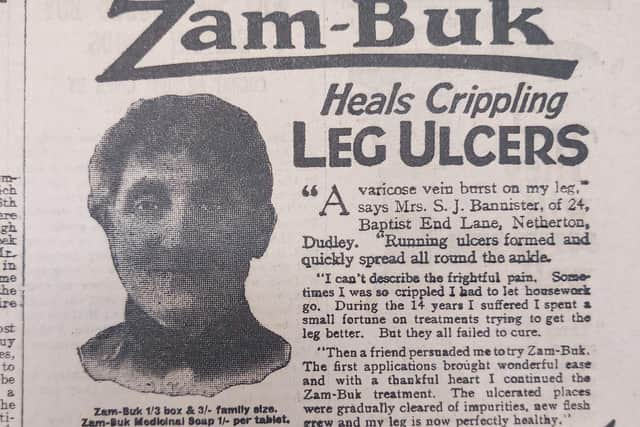
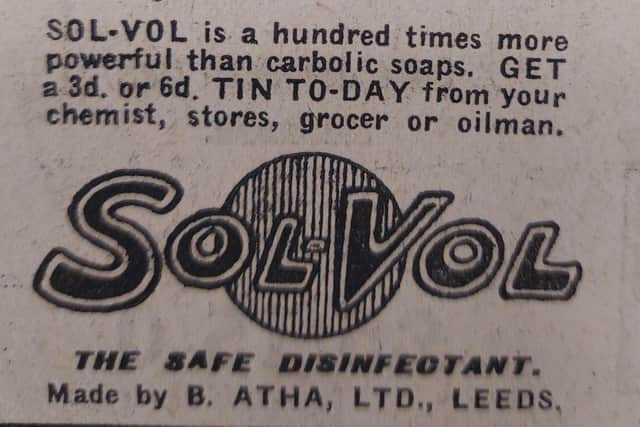
Zam-Buk, for example, was sold as a miracle cure for leg ulcers and Sol-Vol was supposedly 100 times more powerful than carbolic soap in maintaining decent sanitation.
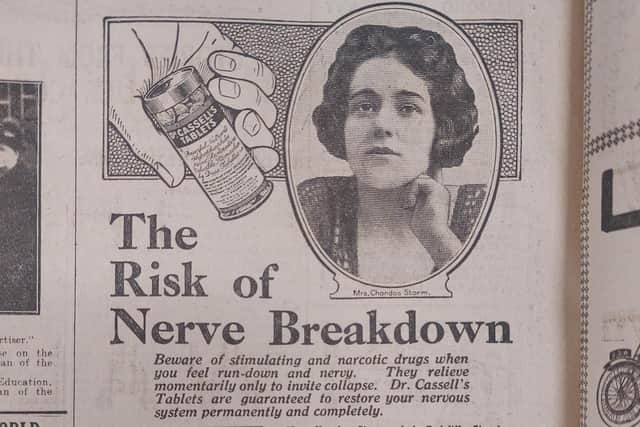
Bugs, flies and fleas could be eradicated from wardrobes by Keating’s Powder (“Keating’s Kills” said the blurb) and Dr Cassell’s Tablets were “guaranteed” to restore the nervous system “permanently and completely” in the case of a nervous breakdown. “Beware of stimulating and narcotic drugs when you feel run-down and nervy,” said Dr Cassell, “They relieve momentarily only to invite collapse”.
“Good News for Mothers” was offered by Clarke’s Blood Mixture which made the astonishing claim that it could cure the diseased hips of their children. “Crutches and Splints Soon Thrown Aside,” the ad dramatically asserted.
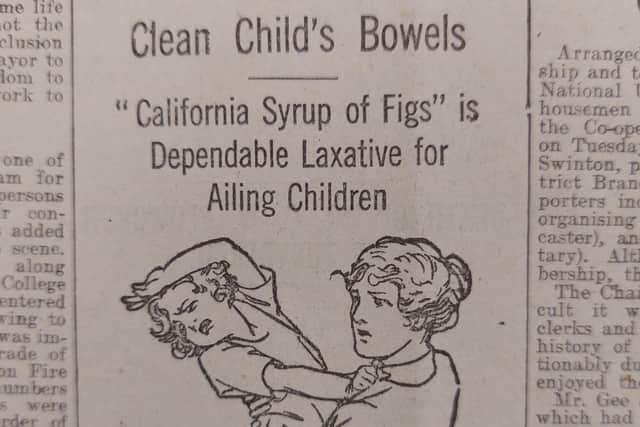
More traditional remedies were also pushed. “Clean Child’s Bowels,” with California Syrup of Figs the paper urged mothers everywhere, and D Hobkinson & Son of Frederick Street, Rotherham, encouraged housewives to “Make fruit and salads an essential part of your summer diet”.
Beauty was then, as it is now, a big driver of adverts. As was envy and the desire to fit in. One hair care ad, for example, said: “Most of your friends will shampoo with Amami to-night”. So, clearly, you should be too!
Looking after the home was clearly important to readers. Perhaps after the war there were more people in work and a little more money around.
The Fine Art Furniture Stores on Howard Street, Rotherham, urged people to “Buy a Buoyant and Be Satisfied”, these being their range of wing chairs, all hair stuffed, offering “The Acme of Comfort”.
“Why spoil your home with a shabby suite?” was the perfectly reasonable question asked by Ball and Waite of Wellgate while JAS & Wm Hastings was the place to go for pianos, pianofortes and organs.
This was also the pre-supermarket age where there were no ready meals as such or even ultra-processed fayre.
You could get your hands on Bird’s ‘Spongie’, Davy’s Sausages, or cut-price tea from George Bingham of Effingham Square (“Have you noticed the IF in Thrift?” he asked).
People were also starting to travel more widely, thanks mainly to the country’s extensive railway system (it was bigger then and there were more stations).
The London, Midland and Scottish Railway (LMS) offered third class return tickets to Blackpool, for instance.
The cinema was also a huge source of entertainment back then. It was still silent films as the talkies didn’t appear until the early Thirties. One advert for the Empire Super Kinema in Rotherham took out a big ad to tell cinemagoers that Charlie Chaplin’s epic Gold Rush was being retained for an extra week. He was a huge star and did big business.
Back then, cinemas attracted the patronage of thousands each week and stars like Chaplin, ‘It’ girl Clara Bow and Louise Brooks were huge magnets for people.
That level of interest in “the pictures” is hard to comprehend these days, sadly.
Taking a look back at the Advertiser’s ads a century ago is an interesting experience, as it is looking back at the old ads in any newspaper. They reflect different priorities and needs and are a fascinating data source for anyone interested in social history.
More interesting sometimes than the news stories of the time!